Champions of the Golden Valley 2025 Movie Review
In Champions of the Golden Valley, director Ben Sturgulewski weaves together the fragile beauty of a sport and the brutal realities of geopolitics to portray a deeply affecting narrative of perseverance, community, and dislocation. The film begins with a lyrical reverie: sweeping black‑and‑white frames of snow and isolation, of a landscape that seems almost eternal, as the voice of Alishah, a coach‑instigator and dreamer, reflects on how a dream can both bind one to a land and wrench one away from it.
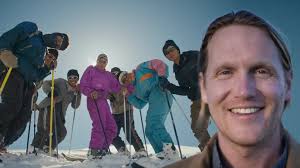
Early scenes transport us to remote mountain villages in Bamiyan Province, Afghanistan, where skiing has taken root almost improbably. Driven by minimal resources, rival communities rally behind a homemade annual race organized by Alishah, pitting young athletes from once-warring villages against one another in contests of endurance, determination, and ingenuity.
The film’s greatest strength is its capacity to shift tone without losing coherence. For the first act, the mood is quietly celebratory: villagers carve skis out of wood and discarded materials, bind them with milk‑jugs or straps, climb the slopes by foot, and descend with a kinesthetic joy that reminds the viewer how pure motion can feel like freedom. The races—as organic as they are primitive—become communal rituals in which distinctions of clan and history blur, in which sport becomes a tenuous but luminous bridge between fractured places. Sturgulewski’s lens captures the texture of the land—the wind, the light, the silence—with a reverence that enfolds us into the lives of his subjects.
But then the film pivots. The joyous experiment in collective uplift is threatened by history’s weight: the Taliban’s return to power, the collapse of structures, the dissolution of safety. In the later portion, hardships mount: the athletes and their families are forced to flee, to scatter, to reckon with displacement and exile. The narrative becomes less about mountain races and more about what it means to carry a homeland in memory, to survive when the ground beneath you is no longer yours. This structural tension—between the exhilaration of sport and the ugliness of political violence—is not superficial. Sturgulewski does not frame the descent into chaos merely as external tragedy, but probes the inner landscape of his subjects: the guilt of survival, the fractures of identity, the fear that their ambitious project might vanish as though it never existed. In one haunting moment, Alishah reflects on his dream’s mortality: a dream that once inspired, now seems vulnerable to erasure.
Yet the film is not purely elegiac. It feels suffused with an argument about what hope can mean in exile. The displaced athletes, scattered across Europe and elsewhere, must carry within them the contours of their former lives—both the scars and the sense of possibility. The documentary does not shy from acknowledging their ruptures: interviews, footage of loss, quiet confessions of regret and uncertainty remind us how tenuous are the bonds of place once uprooted. But Sturgulewski also lingers on how lessons learned in that remote snow land—in resilience, collaboration, resourcefulness—shape the exiled selves, inform new identities, and sustain hopes even when uprooted.
Cinematically, Champions of the Golden Valley is austere but expressive. The contrast between the silent expanses of snow and the human presence is often arresting: a lone skier in silhouette, dust swirling around simple tools, children racing against each other down a slope. The camera moves between the intimate and the panoramic, giving us both close-ups of calloused hands and wide shots of a universe that seems indifferent yet holds them. The use of archival and on‑the-ground footage creates a temporal layering: what is captured feels subject to change, to fragility.
Critically, the film’s ambition is not to romanticize. As one reviewer notes, while the imagery is “shiny” and beautifully composed, the film sometimes treats grand historical shifts—the U.S. exit, the Taliban takeover—as almost happenstance, external to the human dramas That tension is valid: the challenge for a film of this kind is to hold both the small and the large, to not let either collapse under the weight of the other. Moments of narrative unevenness emerge, especially in transitions between the hopeful ski phases and the darker aftermath, when the film must recalibrate its emotional axis. Some details of the geopolitical context—how the resettlements happened, how the athletes negotiated entry into new countries—are treated more as postscript than deep inquiry. Yet the emotional throughline holds; we stay with the stakes, and our investment in the characters deepens as we sense the fragility of what was built.
The performances—if one may call them so in a documentary—are raw and compelling because they are real. Mujtaba and Hussain Ali, two skiing champions from rival villages, emerge not as branded protagonists but as humans whose ambitions are tethered to land, history, and hope. Their voices—soft, sometimes broken, sometimes resolute—embody the contradictions of belonging and loss. Even when they falter, they retain dignity. The supporting voices—of other skiers, of villagers, of family—enrich the tapestry, reminding us that this is not a spectacle but a shared experiment in beauty and survival.
One of the film’s subtler threads is gender. In the early phases, when Alishah begins to include female skiers, the very act becomes a small revolution: “they realized girls can ski,” he observes, “they are no different from boys.” In a cultural context where female athleticism is often constrained, this moment of agency is quietly radical: a sports project doubling as a social statement. The downstream dissolution under conflict threatens this glimpsed progress, but the archival record—and the testimonies—keep alive the memory that change is possible, even if fragile.
As a documentary, Champions of the Golden Valley is not without its compromises. Its ambition outpaces its width: some viewers may long for more context on Afghan politics, deeper expository passages on the refugee transition, or more sustained attention to the ways individual lives were remade in diaspora. Because the narrative is sometimes elliptical—leaping from slopes to airports, from snow to exile—we occasionally feel unmoored. But perhaps that disorientation is part of the point: when uprooted, even memory can fracture, and the film refuses simple reconciliation.
In the moral domain, the film invites us to ask: what is a champion? Is it the fastest across the finish line? Or is it someone who carries hope in their bones when their landscape is torn apart? The concluding sequences—of exile, longing, persistence—suggest the latter. The athletes’ lives become metaphors not for triumph alone but for survival, and for the stubborn insistence of human dignity in contexts that attempt to strip it away. In that sense, the documentary becomes a kind of elegy and a call.
Champions of the Golden Valley is, in sum, a film deeply alive to paradox: it celebrates the irreducible human impulse to dream in adversity, even as it refuses to sentimentalize. While it occasionally falters under the weight of historical complexity or narrative compression, its emotional core and visual poetics make it a memorable watch. It is less about delivering answers and more about bearing witness—to land, to loss, to the fragile persistence of hope. For viewers attuned to stories of exile, of sport beyond spectacle, and of communities striving against erasure, this film offers much: not consolation, but testimony.