Black Phone 2 2025 Movie Review
The Black Phone 2 is a bold, audacious sequel that leans hard into the supernatural and the nightmarish, trading in some of the psychological subtlety of its predecessor for grander, bolder strokes. Directed and co-written by Scott Derrickson (with C. Robert Cargill), the film picks up four years after the events of The Black Phone, revisiting the horrors of The Grabber in a new era and with escalated stakes. At its core, Black Phone 2 is as much about trauma, family, and faith as it is about gore and supernatural terror — and in attempting this amalgam, it delivers both powerful highs and jarring missteps.
The setup reintroduces us to Finney Blake (Mason Thames), now 17, struggling to live with the weight of being the sole survivor who killed the Grabber years ago. He is haunted not just by memories, but by the lingering whispers of the black phone itself — a spectral line that connects him to past victims and to a sinister force beyond death. His younger sister, Gwen (Madeleine McGraw), becomes the focal point this time: plagued by horrific visions of mutilated children under frozen ice and cryptic calls in her subconscious, she becomes convinced these dreams tie to a winter camp her mother once worked at. She drags Finney along to the Alpine Lake camp — isolated and blanketed in snow — in search of answers and to confront the evil that seems as active as ever. The film’s villain, the Grabber (replayed by Ethan Hawke), has evolved: his presence now extends beyond death, his abilities stretching into the dreamworld. It’s a gambit that turns the already creepy lore of the first film into something more extreme, more monstrous, more vivid.
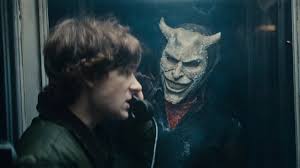
From a technical standpoint, one of the film’s most striking features is its visual language. Derrickson leans fully into analog horror aesthetics — hazy 8mm-style footage, jittery camera movement, dream sequences that dissolve and fragment — to evoke a sense of temporal dislocation, as though the viewer has tuned into a cursed VHS tape found in a forgotten thrift store. These visuals pay off especially in sequences where Gwen answers the phone or steps into surreal environments: the atmosphere, flickering and uneasy, often outpaces exposition in its power to terrify. One standout moment finds Finney in a phone booth standing against a snowy void, the camera spiraling around to reveal ghostly apparitions adorning the landscape — a sequence that captures the film’s ambition to make its audience complicit via cinematography. The snowbound camp setting, too, plays to Derrickson’s strengths: cold, stark, claustrophobic despite its wide-open whiteness. Tension thrives in those silent moments, when only the echo of footsteps or a crack in the ice breaks the silence.
However, the film is not without its narrative and tonal challenges. One of the critiques that surfaces in multiple reviews is the portion where Black Phone 2 leans heavily into explanation. A lengthy section in the middle of the film functions as expositional scaffolding — detailing the history of the camp, the lore of the Grabber, and Gwen’s connection to her mother’s visions — and in doing so, sacrifices momentum. Roger Ebert’s reviewer Brian Tallerico notes that the movie is “a tick too long and has a section that’s far too expository” for a horror tale that does best when it trusts its imagery over its dialogue.
Indeed, when the film is busy telling instead of showing, it loses some of the dread that its early scenes so promisingly establish. Several critics have also flagged the film’s insertion of overt Christian themes — characters invoking Jesus, speaking of heaven, or having faith-based dialogue — as feeling tonally awkward and underdeveloped. In Dread Central’s Fantastic Fest review, the fusion of slasher violence with moments of religious moralizing is described as a “weirdly Christian after school special energy,” with lines like “I think it’s hot you speak to Jesus” underscoring an awkward thematic shift. This tension between sacred and profane sometimes jars rather than enriches, and may distract more than it illuminates. Additional voices echo this: Slant Magazine describes the collapse of dreams and reality as seductive, but warns that certain motifs feel borrowed and overburdened. Bloody Disgusting, meanwhile, praises the cast and vision but notes the film, despite its ambition, doesn’t always land.
In terms of performances, Black Phone 2 achieves some real strengths. Madeleine McGraw’s Gwen anchors the film with quiet ferocity, conveying vulnerability and determination in turns, and providing a strong emotional core. Mason Thames, as Finney, wrestling with guilt and survivor’s anger, does well when the script lets him inhabit silent grief, even if some dialogue pushes him into more stereotypical “traumatized teen” territory. Ethan Hawke, returning as the Grabber, is at once repulsive, magnetic, and unnervingly venomous, particularly when he invokes his power in dream realms. Critics across multiple outlets note that bringing Hawke back — even though his character died — is one of the film’s boldest gambits, but he remains one of its strengths. The ensemble is rounded out by Demián Bichir (camp supervisor Armando) and Arianna Rivas (Mustang), who bring a grounded presence to a narrative increasingly untethered from realism. But even with this cast, the film occasionally falters when the dialogue veers too didactic or clunky — a criticism echoed in multiple reviews.
As for its success relative to the original, Black Phone 2 is divisive, but ambitious. On Rotten Tomatoes, it holds a respectable 80 % Tomatometer score (based on 25 reviews) and is characterized by reviewers as well connected to its predecessor yet possessing its own identity. any critiques hail it as an improvement: GamesRadar notes praise calling it “tremendous” and “nightmarish,” with even Stephen King reportedly preferring the sequel. The narrative shift — from the confined horror of basement abduction in the first film to the open, dream-haunted wilderness of winter camp — indicates a willingness to expand the mythology. Roger Ebert’s review describes the film as a conscious homage to Nightmare on Elm Street, but one done with enough daring to feel newly its own. Dread Central argues it “goes absolutely wild in a way that only a supernatural slasher can,” though it also warns of tonal inconsistency. Some dissenters feel the sequel doesn’t quite capture the quiet, chilling dread of the first; they point to the first’s disciplined tension and relative restraint as a benchmark the sequel sometimes overlooks. In the Reddit “Review Thread,” one user sums up a common critique: “The biggest criticism I see is that it borrows heavily from Nightmare on Elm Street.” Nevertheless, many fans welcome that borrowing, seeing it as a natural evolution for the Grabber mythology: from masked mortal killer to dream-invading terror.
Thematically, Black Phone 2 wrestles with the nature of evil, trauma’s lingering echoes, sibling devotion, and the possibility of transcendent faith. The film posits that evil, once unleashed, can escape its bounds — that trauma survives not just in memory but in the very fabric of dreams. Gwen’s visions of ice-bound children and the ability of the black phone to reach across time suggest that the past is always present, and that to heal, one must face not just the monster, but one’s familial legacy. Faith and prayer are woven into this confrontation, suggesting that spiritual belief might be a tool as potent as fear. That said, the intermingling of horror and religiosity does not always feel seamless; at times the messaging feels more like overlay than integration.
Black Phone 2 stumbles when it leans too heavily on explanation or moralizing, but soars at moments when it abandons narrative restraint in favor of visuals, dread, and sensory immersion. Its strengths lie in set-pieces that defy expectations — a kitchen sequence that twists domestic terror into supernatural lock-in, a phone booth attack that heightens tension through rotating camera tricks, and sequences in the ice that evoke both fairy tale dread and classic slasher showdowns. The film’s willingness to push boundaries — in gore, in tone, in the hybrid of genres — is admirable, even if it doesn’t always land.
For viewers who loved The Black Phone for its tension, restraint, and tight focus, Black Phone 2 may feel like a wild leap — sometimes exhilarating, sometimes overreaching. But for those open to the film’s ambitions, it offers a richly textured horror sequel that isn’t afraid to play with time, faith, visuals, and fear in equal measure. In the end, it might not be perfect, but it demonstrates the kind of boldness a horror sequel needs to be worth making.