Kill Bill: The Whole Bloody Affair 2025 Movie Review
Kill Bill: The Whole Bloody Affair remains one of the most singular cinematic experiences of Quentin Tarantino’s career, and revisiting it in 2025 only sharpens how strikingly cohesive, emotionally charged, and stylistically fearless it is when the two individual volumes are seen as a single, uninterrupted saga. The film, long considered the “true” version of Kill Bill, takes the viewer on a relentless, hyper-stylized odyssey of vengeance, identity, and catharsis, yet what becomes clearer with time is how beautifully it balances operatic excess with genuine emotional stakes. Across its sweeping runtime, the film becomes something far richer than a revenge epic: it becomes a meditation on survival, trauma, and the life-altering cost of reclaiming oneself from devastation. Watching it today, in a cinematic landscape often dominated by CGI-heavy spectacles and franchise formulas, The Whole Bloody Affair feels refreshingly handcrafted, an unapologetically personal work built from Tarantino’s encyclopedic love of genre cinema and his deepening understanding of character-driven storytelling.
What strikes first, even after two decades, is just how deftly the pacing benefits from this unified presentation. In the original two-volume release, the stylistic differences between Vol. 1 and Vol. 2 were intentional, but abrupt—the first half a blood-splashed samurai-western hybrid, the second a slow-burn character drama. When merged, however, those contrasts feel purposeful rather than jarring. The tonal shift becomes a kind of narrative inhalation and exhalation. The first half—violent, stylized, kinetically charged—serves as the external manifestation of The Bride’s rage. The second half—quieter, more introspective, less drenched in gore—feels like the inward journey she must take as she confronts the emotional truth buried beneath her revenge. The momentum never feels compromised; instead, it guides the viewer through an emotional arc that grows exponentially more complex. In this form, the film becomes a more fluid cycle of escalation and reflection, mirroring The Bride’s path from survival to reckoning and finally to reclamation.
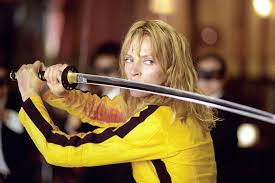
Uma Thurman’s performance remains the anchor that allows the film’s genre exuberance to become deeply human. In this complete version, her transformation is easier to track as a continuous evolution rather than a two-part journey. Her portrayal of Beatrix Kiddo (finally named fully and without the playful gag of the censor bleep) is still one of the most physically demanding and emotionally layered performances in modern action cinema. She carries the movie with a mixture of ferocity and wounded vulnerability, and the integrated narrative structure allows the viewer to feel the weight of her losses accumulating without the interruption of a months-long gap between releases. The quiet scenes of Beatrix confronting her trauma—particularly her moments of fear, grief, and confusion regarding her stolen motherhood—hit harder when not separated by a volume divide. The result is a character who feels more tragic, more sympathetic, and more fully realized. Her violence, while balletic and extravagant, never reads as empty spectacle; it is tethered to a profound emotional core.
The supporting cast, too, benefits from this seamless structure. Vivica A. Fox’s Vernita Green feels more impactful as the opening adversary in this continuous narrative. Her death becomes the detonator for the long emotional chain reaction that follows. Lucy Liu’s O-Ren Ishii is presented with the fullness her character deserves: not just as a stylish antagonist, but as someone whose own violent backstory mirrors and refracts Beatrix’s. The anime sequence that recounts O-Ren’s childhood trauma feels less like a stylish detour and more like a thematic reinforcement that violence and vengeance are cyclical forces that shape and scar women differently than men in Tarantino’s world. Daryl Hannah’s Elle Driver, meanwhile, becomes an even more potent foil. The pacing allows us to understand her as The Bride’s dark reflection—her cruelty, her jealousy, and her hunger for Bill’s approval representing everything Beatrix could have become had she lost herself completely.
And then there is Bill. David Carradine’s performance grows in potency when not withheld until the second volume. His spectral presence hovers over the entire merged film, giving the story a mythic weight. When he finally appears, the cumulative emotional pressure makes the quiet conversations between him and Beatrix—particularly the iconic “Superman monologue”—feel like the inevitable summit of everything that came before. Carradine’s calm, philosophical menace becomes a chilling counterpoint to the film’s stylized violence. Their final confrontation, understated yet devastating, lands with even greater force in the uninterrupted cut, highlighting that The Whole Bloody Affair is ultimately less about killing Bill than confronting the web of control, pain, and betrayal that defined Beatrix’s former life.
Stylistically, the film remains one of Tarantino’s most impressive achievements. His pastiche sensibilities are on full display—spaghetti westerns, kung fu cinema, Italian giallo, exploitation flicks, and anime all coexist harmoniously—but the unified cut demonstrates how skillfully he stitches these influences into a cohesive narrative tapestry. The pacing of the House of Blue Leaves sequence, restored in its full uncut glory and even more graphic than the original U.S. release, is breathtaking: a masterclass in action choreography, rhythm, and visual storytelling. The violence is stylized yet purposeful, and the long take that follows The Bride as she approaches her enemies feels even more immersive in the restored version. Meanwhile, the quieter western influences of the second half, including the dusty landscapes and Morricone-inspired cues, play beautifully as a thematic and stylistic counterweight. Together, they turn the film into a global tribute to genre cinema, but also into a sharply focused story about a woman reclaiming her life with every weapon at her disposal.
The editing in this combined version deserves particular praise. Without the need for recap sequences or volume-specific rhythms, the film’s structure becomes more elegant and deliberate. Tarantino’s typical nonlinear storytelling is still present, but here it feels more emotionally resonant. The flashbacks land with added significance because they connect more fluidly to the forward momentum of the narrative. The film benefits immensely from this enlarged emotional continuity: Beatrix’s training with Pai Mei and her evolving moral conflict with Bill feel interwoven rather than compartmentalized. Even the humor—so often overlooked in discussions of Kill Bill—becomes more effective. The absurdity and hyperbole contrast against moments of real pain, humanizing the story in unexpectedly soft ways.
Yet what truly elevates The Whole Bloody Affair in 2025 is how well it has aged compared to so many modern action films. The practicality of the stunts, the physicality of the performances, and the reliance on stylized choreography rather than digital enhancement give the film a timeless quality. The exaggerated sound effects, the bold splashes of color, the sudden shifts in aspect ratio—all the things that might have seemed ostentatious in lesser hands—become part of a visual language that is unmistakably Tarantino. In an era where action sequences often feel weightless, the visceral tactility of Kill Bill is almost shocking. You feel the sweat, the dirt, the pain, the exhaustion. The story’s emotional stakes remain grounded even when the style becomes ecstatic.
Watching the film now also invites reflection on Tarantino’s evolving legacy. With the director having announced and delayed several “final films” over the years, The Whole Bloody Affair stands as a reminder of his ability to balance indulgence with craft. It is a movie unconcerned with convention but obsessed with precision. If anything, its completeness feels more apparent now: this is perhaps the most total expression of his love for cinema’s past while still forging something distinctly modern and personal. It is a younger Tarantino’s maximalist vision executed with an older Tarantino’s restraint and emotional maturity—an unusual combination that has aged remarkably well.
Despite its sprawling nature, the film’s emotional endpoint is surprisingly intimate. The final sequence, in which Beatrix quietly breaks down after escaping with her daughter B.B., resonates even more strongly in this unbroken format. It is as if the film finally exhales after holding its breath for the entirety of its brutal, operatic journey. The tears, the shaking relief, the fragile laughter—all of it reminds the viewer that beneath the iconic yellow tracksuit and stylized gore is a deeply human story about a woman who refused to stay broken. The thematic power of this moment becomes undeniable when the journey leading to it is uninterrupted: she has not simply avenged herself; she has reclaimed the parts of her identity that Bill tried to rewrite.
In 2025, Kill Bill: The Whole Bloody Affair stands taller than ever as both a cinematic spectacle and an emotionally resonant character study. It is a brutal film, but never a hollow one; a stylish film, but never a superficial one. Its fusion of genres feels even more fearless now, and its exploration of trauma, empowerment, and rebirth has only deepened with time. If the original volumes were impressive achievements in their own right, the unified cut reveals the full scope of what Tarantino intended—a mythic, violent, deeply human epic whose emotional heartbeat only grows stronger in this definitive form. It remains not just one of Tarantino’s most accomplished works, but one of the most enduringly powerful action films of the 21st century.