In Our Blood 2025 Movie Review
“In Our Blood,” directed by Pedro Kos, is a daring hybrid of documentary-style storytelling and horror-thriller that lingers in the mind long after the credits roll. The film begins with what feels like a simple, emotionally framed premise: filmmaker Emily Wyland (Brittany O’Grady) and cinematographer Danny Martinez (E.J. Bonilla) travel from Los Angeles to New Mexico to reconnect with Emily’s estranged mother, Sam (Alanna Ubach), after years of silence. The early scenes, bathed in small talk, awkward reunions, and the tentative hope of reconciliation, create a quietly uneasy tone: what seems on the surface like a family-drama documentary gradually reveals darker undercurrents.
The found footage aesthetic that Kos employs is more than a stylistic choice; it’s essential to the film’s unsettling power. Because he comes from a documentary background, Kos is less interested in jump scares than in capturing the texture of human fragility. The cameras linger: on the cracks in the walls, on the faces of people worn down by addiction, on interviews that teeter between confession and defense. As misgivings grow and Sam vanishes, the quest to find her becomes a spiral into places more sinister than simple familial estrangement.
One of the film’s greatest strengths is its treatment of addiction, marginalization, and the people who slip through society’s cracks. What begins as a personal search becomes an exploration of a community ignored—homeless populations, struggling addicts, and those whose disappearances go unreported. In weaving this larger context into the narrative, Kos avoids sensationalism: the film does not exploit tragedy but seeks to give it weight, to ask what it means to vanish, to be forgotten, to be vulnerable in plain sight. Reviewers have praised this sensitivity, noting that the film “sensitively deals with addiction” and “delicate handling of recovering addicts” add texture beyond the genre’s demands.
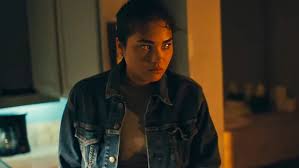
Brittany O’Grady anchors the film as Emily, a character at once drained by her past and driven by a mixture of guilt, love, and urgency. O’Grady walks a difficult line: she must remain approachable, flawed, tearful, and resolute. The progression of Emily’s mindset—from hopeful to desperate to outraged—is compelling, and O’Grady never overplays it. E.J. Bonilla complements her by bringing grounded realism as Danny. His occasionally skeptical, cautious voice from behind the lens acts as both counterbalance and emotional anchor. Their rapport, even in silence, gives the narrative something to grip onto, and many reviewers have singled out their chemistry as a core reason the film remains involving even during quieter stretches.
The film’s pacing is deliberate. For much of its runtime—around 89 minutes “In Our Blood” moves like a detective thriller. Clues drip in: contradictory statements, offhand gestures, closed doors, people too afraid to speak fully. Occasionally, the tension slackens—some critics argue the first act is slow, the mystery not compelling enough on its own—but the sense of foreboding never wholly lets up. As the investigation deepens, the film shifts gears, transforming from documentary-tinged mystery into something more primal and horrifying.
The turning point emerges in the third act, when the horror elements—less hinted at than held in reserve—become unavoidable. Without spoiling the reveals, the final sequence reconfigures what we’ve seen. Motives, identities, and alliances invert; the documentary framing begins to cannibalize itself, and Kos pushes the form to its breaking point. Critics have noted the film’s “bold, bloody ending,” one that reframes preceding events and asks uncomfortable questions about the boundaries of witnessing. In that moment, the film stops being a search for a missing woman and becomes a reckoning—not just with what is hidden, but with what we choose to look at.
Yet this is also where the film’s ambitions are most visible—and, for some, most precarious. Some critics argue the genre twist arrives too late or feels tacked on, that the horror portions threaten to overshadow the human story Kos has labored to build.Others accept the finale as a necessary risk, a bold gambling that yields more reward than not. The imperfect balance is part of the film’s audacity.
Technically, “In Our Blood” is impressively assured. The cinematography captures New Mexico’s barren landscapes and isolated spaces with an unpretentious accuracy: places don’t feel like sets but lived terrain. Light and shadow, off-kilter framing, and the grain of the footage all reinforce the sense of observation. Kos resists going for sleek gloss; instead, the film feels bruised and vulnerable. Sound design is often minimal—silence, natural ambiance, the hum of electronics—so that when the film does insert an unnerving noise or distant echo, it has impact. That restraint underscores the core tension: what you don’t see, what you hear only half, becomes more terrifying than what you do.
Thematically, “In Our Blood” isn’t content to simply scare. At its heart is a collision of memory, accountability, and erasure. How do we contend with family members who falter, who vanish, who slip into anonymity? What obligations do children have toward parents who struggled? In the film’s world, absence is not benign; it’s symptomatic of deeper fractures in society. As the documentary lens turns back on its creators—forcing Emily, Danny, and the audience to reckon with the ethics of filming people in crisis—the film asks: who is owed attention? Who becomes spectacle? And who remains invisible?
While the film’s ambitions are bold, it doesn’t always land perfectly. The final act, while powerful, feels like it could have used further interrogation or tightening. A few narrative threads are left dangling; some motivations go under-explored. A couple of tonal shifts—especially in the transition to full horror—feel abrupt. And some viewers may find that the documentarian conceit strains credulity: why keep filming in increasingly dangerous moments? Still, Kos generally avoids overextending, and many of the choices feel intentional, not careless.
Moreover, the film’s moral weight is enhanced by small gestures. In the closing credits, real people from a “transitional community” appear, giving unscripted voices to lost and homeless individuals. That decision reminds the viewer that the fiction here is tethered to real marginal lives—people whose stories are often ignored. In doing so, “In Our Blood” resists the selfish voyeurism that horror sometimes embraces; it pushes the gaze outward and back.
When the film works best, it is haunting—its quiet moments seeping under the skin, its reveals forcing reflection. Brittany O’Grady’s performance haunts; Danny as camera bearer becomes a kind of proxy for our own guilt and fear; Sam’s absence is more potent than any monster. The tension between exposure and protection is central: filming is an act of risk, but silence is an act of erasure.
In sum, “In Our Blood” is a provocative, uneasy, and deeply felt film. It may not satisfy every expectation of horror purists, and some of its narrative turns ask more of the audience than they give. But the film offers a rare fusion of social realism and genre terror—and in doing so, presents horror not as escapism but as confrontation. Its lingering mysteries, moral fractures, and emotional scars invite repeated thought. Pedro Kos’ transition into fictional storytelling is a promising one, and “In Our Blood” marks a bold statement: that the personal and the communal can—and perhaps must—converge in the cinema of fear.