Tron: Ares 2025 Movie Review
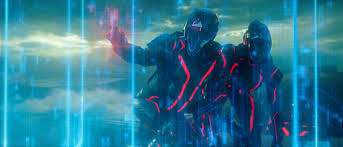
“Tron: Ares” is the third installment in the “Tron” film series and the sequel to 2010’s “Tron: Legacy”. Directed by Joachim Rønning (“Maleficent: Mistress of Evil”, “Young Woman and the Sea”) and starring Jared Leto, Greta Lee, Jodie Turner-Smith, and Evan Peters, it boasts state-of-the-art visuals and a great soundtrack at the expense of an engaging story and characters.
Sometime after the events of “Tron: Legacy”, Dillinger Systems CEO Julian Dillinger (Evan Peters) unveils his newest artificially intelligent program Ares (Jared Leto), capable of transcending the barriers of the virtual world into the physical one. To prevent the AI from going rogue, Julian programs a failsafe that causes Ares to dematerialise back into cyberspace after a set amount of time. However, before he went missing years earlier, former ENCOM CEO Kevin Flynn (Jeff Bridges) managed to create a “Permanence Code” that once enabled will allow AI beings to become a permanent part of the real world,. Having been lost in the cyber world for over a decade, the incumbent ENCOM CEO Eve Kim (Greta Lee) finally discovers the location of the Permanence Code online, immediately alerting Julian to her presence. Now with a major target on her back, Eve must find ways to outmanoeuvre Julian’s dangerous pursuit of the Code, with him sending not only Ares after her but also his equally as deadly second-in-command program Athena (Jodie Turner-Smith).
If there were ever a more definitive showcase of early computer-generated imagery (CGI), one film that stands out the most with its prominent usage would have to be Disney’s sci-fi action adventure movie “Tron”. Released in 1982, the film proved to be a catalyst for the extensive use of CGI in modern moviemaking, pioneering the way this technology would be featured alongside a regularly plotted story. Quickly achieving a cult status among its viewers, the film’s success eventually led to a belated sequel twenty-eight years later with “Tron: Legacy” that again featured visual effects that were revolutionary for that particular time. Another fifteen years later, we now have a third cinematic entry in the series with “Tron: Ares”, which, like its two predecessors, shows us dazzling visuals attuned to today’s technological capabilities that almost compensates for its lacklustre story and forgettable characters.
Establishing its signature cyber vibe right away, the film opens on a collection of online news reports detailing the disappearance of Kevin Flynn, the protagonist from the original 1982 movie. Here, we are informed via numerous CGI reporters that ever since Kevin went missing, the world of technology has advanced considerably over the years, with AI becoming so cutting-edge that it is now possible to transfer objects out of cyberspace and 3D print them into our world. All of this is now a reality thanks to the genius of Julian Dillinger, the grandson of the first film’s antagonist Ed Dillinger (David Warner), who, like his grandfather, harbours similar ambitions to use this technological marvel to aid him in his lust for power within the industry. Though this set-up is pretty decent, it quickly becomes evident that the film will suffer from the same major problem as the two that came before it; being that it is so obsessed with wowing the audience with great visuals that it forgets about every other important element in telling an appealing story.
As the film continues, we learn that Kevin developed a special code that has the power to permanently bring anyone and anything into the real world out of cyberspace, an invention that seemingly disappeared along with him over a decade prior. After searching online for many years, Julian’s rival tech CEO Eve Kim manages to locate the code, which prompts him to track her down using his own personally developed humanoid AI programs known as Ares and Athena. What follows from here on out is a set of chase scenes that involve Eve being on the run from these two throughout a busy city, utilising the same level of cyberpunk effects as before. While these sequences are indeed nice to look at, once you strip away all of the brightly-coloured eye candy, all you end up with is a collection of standard action scenes offering little else that most viewers haven’t already seen before.
One saving grace that prevents the film from being too dull at times is its electronic score, composed by the legendary industrial metal band Nine Inch Nails. Similar to Daft Punk in the second film, the Nine Inch Nails band members Trent Reznor and Atticus Ross inject so much more personality into certain scenes than one would usually expect, salvaging what could have been an otherwise unremarkable moment to the viewer. For instance, one scene that I think could have been forgettable if not for the music was where Ares is in an 80s-rendered cyberspace examining his nostalgic surroundings. Here, Ares acknowledges this place as being reminiscent of the original location where Kevin Flynn once fought to the death against other users. Narratively, this whole segment plays out like cheap nostalgia bait, but thanks to Nine Inch Nails’s lively score, it feels a bit more exciting to people who either aren’t fans of the “Tron” franchise or are newcomers unfamiliar with the already established world.
Continuing his recent streak of unremarkable film roles, Jared Leto does little to pull himself out of his downward spiral as the character of Ares. Whether he is acting this way on purpose or not, Leto’s performance feels so flat that even when he attempts to make it look like Ares is developing something of a conscience, he still feels so uninteresting to watch. Though I understand that Ares is supposed to be an AI program with no real human emotion behind him, this doesn’t do him any favours whenever he is on screen as the central focus of the story. It also doesn’t help Leto’s case that he is credited as an executive producer for the film, meaning that he would have likely had a major say in the creative direction he wanted to take his character, which in this case is stoic and poker faced.
The rest of the cast don’t fair much better either, with Evan Peters’s talents for chewing the scenery going to waste as Julian Dillinger. What could have been a nice callback to his onscreen grandfather David Warner in the original movie is instead another underwritten villain with typical desires for world domination. On that note, it is equally as frustrating to watch Gillian Anderson, an otherwise scene-stealing actress, cast aside for the painfully underused role of Julian’s mother Elizabeth, who only ever shows up to spout off exposition. Jodie Turner-Smith plays Athena as nothing more than a generic subordinate AI soldier of Julian, who does nothing to break away from her programming to remain compliant to her master. The only character I sort of cared about was Eve, whom Greta Lee tries her best to play up with the weak material she has to work with. Even then, Eve has little else going for her aside from the mention of a family tragedy in her backstory, which I suppose is a far more sympathetic character trait when compared to everyone else’s in the movie.
Getting by solely on the merits of its slick visuals and musical score, “Tron: Ares” is a mediocre entry in the popular cyberpunk franchise that fails to leave as much of an impression as the two films that preceded it. It’s such a shame that after three movies, the series still chooses to focus solely around special effects without much thought for everything else. Unless you’re a longtime follower of the series who wishes to see its cyber world expand to somewhat greater heights, I don’t see many other reasons to check this sequel out. Admittedly, the soundtrack by Nine Inch Nails is definitely worth listening to on streaming platforms, but fortunately that doesn’t require you to sit through the entire movie in order to properly appreciate it on a creative level. With all of that said, if there is ever a fourth film released in the distant or not-too-distant future, we could finally have a “Tron” movie that is as visually appealing as it is emotionally grounded. At least I can only hope for such a thing at this stage.