Coyotes 2025 Movie Review
In Coyotes (2025), director Colin Minihan stages a familiar but occasionally potent blend of creature‑feature horror and satirical melodrama, setting its action in a Hollywood Hills residence besieged not just by flames from encroaching wildfires but also by a pack of aggressive coyotes that invade its walls.The set‑up is simple and immediate: the destruction of nature—here in the form of fire—forces wild animals into urban spaces, and a middle‑class family, trapped between human complacency and natural wrath, must survive the night.
From the beginning, Coyotes prods at tonal boundaries, sometimes leaning into absurdist tension, at other times halting to riff on the nervous comedy of people under siege. The film opens with an exterminator hired to deal with rats, establishing a grim humor and tension that quickly slides into mayhem as coyotes kill a small pet and begin to close in on the house. The screenplay (by Tad Daggerhart and Nick Simon) persistently tries to straddle survival horror and satire, and occasionally the two modes feel at odds.
One of the film’s strengths lies in its cast, most notably Justin Long and Kate Bosworth, who play Scott and Liv, a married couple whose relationship dynamics are tested as the crisis deepens. Their real‑life chemistry helps ground the more outlandish elements, lending believable emotional stakes to the terror. The daughter, Chloe (Mila Harris), and a few neighboring figures—including Trip (Norbert Leo Butz) and Julie (Brittany Allen)—serve mostly as narrative fodder or contrast, though Allen’s character occasionally offers glimpses of grounding vulnerability.
Where Coyotes begins to falter is in its visual and creature execution. The coyotes themselves, whether by design or necessity, often exhibit a jarring artificiality: critics have noted that they appear inconsistently animated, disconnected from the physical space of the film, and lacking the visceral credibility one expects from creature horror. Some have even speculated that AI tools might have been used in their rendering. In earlier scenes, these visual inconsistencies are more glaring, but by the later acts, Minihan’s editing and cinematography manage to mask some of those flaws with shadow, framing, and kinetic pacing.
Technically, the film displays both ambition and friction. Its sound design sometimes drowns dialogue under crackling wildfire, howls, or score, weakening dramatic beats rather than amplifying them. Editing occasionally missteps, with awkward cuts or tonal shifts that undercut tension.
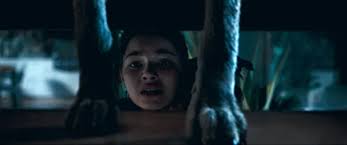
On the other hand, when the film leans fully into its chaos—when power fails, walls are breached, and the coyotes swarm—those moments deliver genuine tension and spectacle.The final third, in particular, finds its stride, staging visceral confrontations that feel earned and dangerous.
Narratively, Coyotes is not shy about injections of thematic commentary. The wildfire as catalyst is no mere plot device; it underscores the broader idea that human encroachment and environmental imbalance provoke backlash. The slogan “Eat the Rich” appears on the film’s promotional materials, hinting at a subtext about wealth, protection, and the illusion of safe spaces in a destabilizing world. In practice, the themes remain surface‑level: the film never quite digs deep into social critique, opting instead to prioritize genre thrills and spectacle. Some characters feel more like devices than fully formed people, and their choices occasionally lean toward convenience rather than motivation.
Still, for audiences willing to lean into genre expectation, Coyotes offers enough payoff. The grotesque imagery—blood, torn flesh, frenzied attacks—arrives with certainty, and a few sequences are beautifully framed in nocturnal terror, using darkness and off‑screen suggestion to heighten unease. The balance between humor and horror is uneven, but when it works, it gives the film a distinct flavor—a kind of carnival ride where you laugh, shriek, and squirm in alternating beats.
Critical reception has reflected this unevenness. On Rotten Tomatoes, the film holds a 79 % approval rating, suggesting many critics appreciated its energy and ambition, though not uniformly. Brian Tallerico of RogerEbert.com called it “a missed opportunity,” remarking that it “never quite finds its pulse” as a survival thriller. The Wrap praised Minihan’s ability to deliver “gnarly horror,” even if the narrative did not always cohere. Other voices were harsher: some critics labeled the human characters “unbelievably … stupid,” while others noted that the film occasionally settles into sentimental or predictable turns.On balance, most agree the film works best when it doesn’t try too hard to be profound—when it’s content to unleash animals, fire, and human panic in succession.
From a pacing standpoint, the film keeps things brisk: at around 92 minutes, it doesn’t overstay its welcome.
The early world‑building is rapid, establishing hazard after hazard (fire, downed communication, physical isolation) before the predator threat even fully blooms.The downside is that emotional arcs sometimes feel rushed or undercooked; the urgency tends to carry the scene more than character evolution.
In terms of tone, Coyotes will likely divide viewers. Fans of B‑movie horror and creature features may delight in its ruthless set pieces, over-the-top spatter, and dark humor. Those seeking more grounded survival drama or deeply drawn characters may find the film wanting, especially when its pacing and VFX quirks intrude.
Its comedic impulses sometimes feel grafted on—little jokes or character beats that undercut tension rather than amplify it—but at its best, the film reminds you that in horror, the simplest premise—animals attacking inside your home—can still terrify when staged with gusto.
If Coyotes had a fatal flaw, it may be a lack of consistency. It aims too high for a pure creature flick yet never quite gives enough weight to thematic or emotional resonance to achieve that middle ground. When its humor is off, it feels jarring; when its effects are exposed, the illusion fractures. Yet when the film leans confidently into darkness—when coyotes prowl in silhouette, glass shatters, panic spreads—the tension grips. In those moments, Coyotes achieves what it sets out to do: force us to consider how fragile our safe spaces are, and what might happen when the wilderness reclaims its territory.
For viewers heading into the theater expecting elegance or innovation, Coyotes may disappoint. But for those willing to flick off seriousness and embrace a late‑night creature carnival, it’s a satisfying minor entry into the horror canon of 2025—a film that bites even if it doesn’t fully roar.