Prison Cell 211 2025 Tv Show Review
Prison dramas are strange. It’s certainly not my go-to genre when it comes to recommending films or TV shows, and it is definitely not something I gravitate to in my free time. But if I come across one by chance, and if it’s even half-decent, I can assure you that I’ll stick with it all the way to the end. That’s how I came across masterpieces like The Great Escape, Escape from Alcatraz, The Shawshank Redemption, The Green Mile, and The Hurricane. I watched Starred Up for Jack O’Connell, Chopper for Eric Bana, Bronson for Tom Hardy, A Prayer Before Dawn for Joe Cole, Gridiron Gang for Dwayne Johnson, The Longest Yard for Adam Sandler, and Brawl in Cell Block 99 for Vince Vaughn. Also, Chicken Run is undoubtedly up there with the greats. Now, when it comes to TV shows, I don’t show the same kind of zeal. Black Bird is the only one that I actually completed. I started Prison Break but never finished it. And by the time I learned about Orange is the New Black, the ship had already sailed. So, you can understand why I was skeptical about going into Prison Cell 211, and well, the show didn’t do anything to win me over.
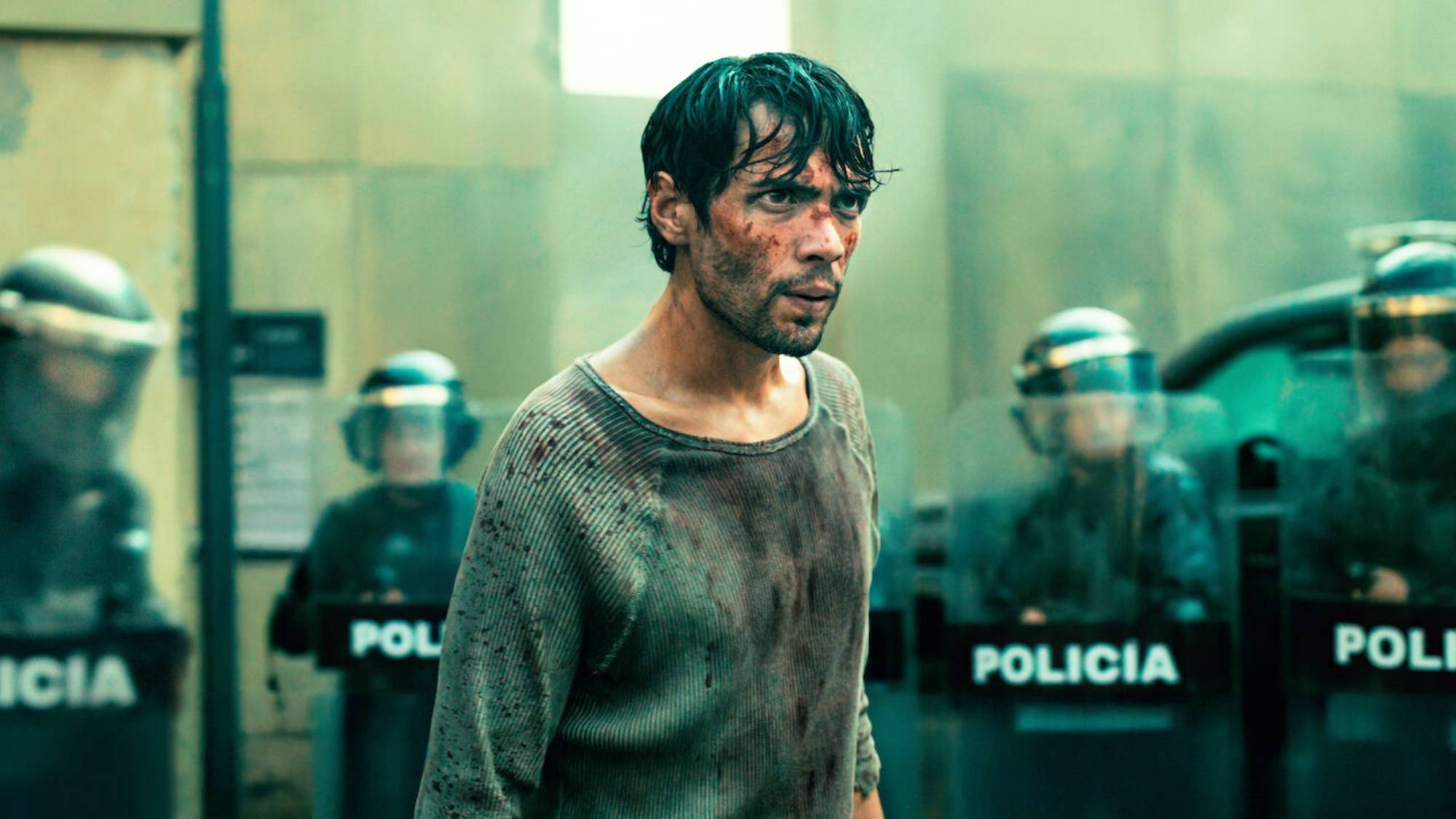
Based on the 2003 novel by Francisco Perez Gandul, Gerardo Naranjo and Jaime Reynoso’s Prison Cell 211, written by Umaru Robles, Gibran Portela, and Benjamin Figueroa, follows Juan, a human rights lawyer who travels to the Ciudad Juarez prison to meet Flavio Gonzalez regarding how she is being treated. Juan’s pregnant wife, Helena, appreciates Juan’s dedication, but with a baby on the way, she essentially wants him to take a desk job so that he doesn’t have to spend a major chunk of his time in various jails. Even if the advice sounds impractical, maybe Juan should’ve considered it because, unbeknownst to him, Calancho, the kingpin of the aforementioned prison, is scripting a riot in order to nab a high-profile inmate, Baldor. Why does Calancho want to do that? For a long time, Calancho has been the pawn of three important people: 25, the boss of the Northern Division Cartel, Gandara, the warden himself and the warden’s second-in-command, Ramirez. And, in return, he has never gotten anything. The subhuman living conditions in the jail and his gang’s enmity with Mostros have driven him up the wall, and he wants to change things up by holding Baldor hostage. However, Juan accidentally gets stuck in the jail during the riot, thereby forcing him to masquerade as an inmate and survive until help arrives.
I’m going to cut straight to the chase and state that the 1st episode and the last 2 episodes of Prison Cell 211 are good; the rest is barely watchable. The introduction to Juan’s predicament and the characters that he has to deal with is quite interesting. The politics that govern the prison, the world outside, and everything that exists in between them are murky and twisted. There’s a promise of some interesting commentary on the culture of Mexico and their relationship with the United States of America. But, for some reason, after this establishing episode, the show sort of goes into a state of limbo. The plot barely moves forward. The characters kind of go in circles. Hence, the threat posed by Calancho and 25 fizzles out. So, you kind of have to endure the next 3 episodes in order to get to some of the meaty stuff again. Now, I must warn you that the reason I enjoyed those last 2 episodes is because I was desperate to see the story go in any direction. If you think about what actually happens in the last hour for even a second, you’ll probably start to realize how contrived Juan’s character arc is, how little information is given regarding the enmity between 25 and Calancho, and the obscure nature of the data in Baldor’s laptop.
After my complaints about the writing, I don’t think anyone will be surprised when I say that the pacing of Prison Cell 211 is absolutely atrocious. The showrunners do this magical trick where they always make you feel that the narrative has reached the point where things are going to pick up, the tension is going to reach the stratosphere, and you will be brought to the edge of your seat; but then none of that happens. Even the most chaotic riot scene is happening; the visual storytelling is so tepid that the gravity of what’s unfolding never registers. Despite being in the middle of that grimy and dirty prison—props to the teams in charge of the production design, art direction, set design, and costume design—you are always made to feel like you’re not an active participant in this tumultuous affair. It’s a one-location show, but nothing about it seems claustrophobic or scary. They try to do something with the aspect ratio; however, it doesn’t work. The whole story takes place in a 24-hour timeframe, but the viewing experience is so boring that you can easily assume that it’s happening over the course of one week. It’s like the showrunners had all the right ingredients, but they were too afraid to cook. I don’t know why. They clearly had the budget. They had the talent. Then where did things go wrong?
As mentioned before, the cast of Prison Cell 211 is extremely talented. Diego Calva puts his heart and soul into his performance. The way he transforms from this meek little guy to one of the most shrewd individuals amidst a prison full of criminals is jaw-dropping. Noe Hernandez is a beast. He is supposed to induce fear, but he ensures that you can see his character’s zeal for freedom throughout the show’s runtime while being intimidated by him. I really love the glasses that he wears, largely because they stand in stark contrast with his overall look. Gerardo Taracena is lowkey hilarious. Ana Sofia Gatica has a physically demanding role, and despite her small screen time, she manages to be impactful. Karina Gidi deserved better writing because she doesn’t get enough footage even though her character is so pivotal. The same can be said about Ursula Pruneda because she doesn’t get to showcase the range she possesses. Alejandro Puente is aptly annoying. Ernesto Godoy is kind of wasted even though he is the show’s big bad. Antonio Fortier, Antonio Monroi, Armando Silva, Rodrigo Magana, and the rest of the supporting cast are great. I don’t have any complaints against any of the actors; I just hate the writers and the directors for giving them such subpar material.
Until I sat down to write this review, I didn’t know there was a feature film adaptation of Cell 211. Yet, my instincts kept saying that Prison Cell 211 should’ve been a movie. I can imagine that maybe the showrunners read the story and thought that its characters and politics deserved the episodic treatment. But here’s the thing: everything about the show seemed like the showrunners were fulfilling an obligation rather than telling a story they liked the way they wanted to. I could be totally in the wrong here; however, I felt that they were stretching a script for a feature-length film into a show because Netflix wanted to feed it to its algorithm and keep their viewer base hooked to the streaming platform for as long as possible. Everyone knew that there wasn’t enough meat on the bones of this plot, yet they tried. Well, if that’s the case, then kudos to them. I hope the pay was good because the show certainly wasn’t. Hence, it’s going into my ever-growing list of shows that should’ve been movies and joining the likes of 1992, Bank Under Siege, Senna, The Last Night at Tremore Beach, Fool Me Once, The Railway Men, and The Witcher: Blood Origin.